



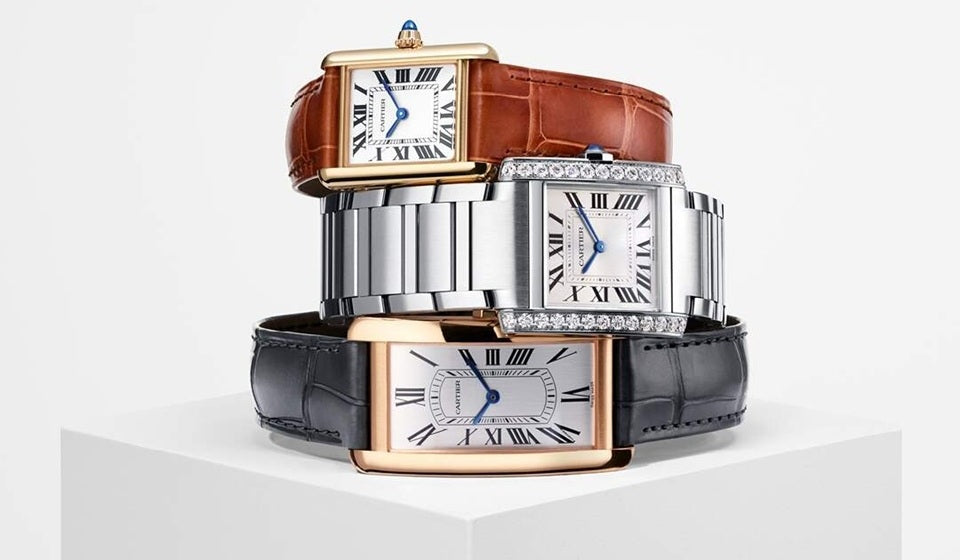
Born from the imagination of Louis Cartier in 1917, the Cartier Tank watch was inspired by the Renault tanks used during World War I. Its bold, geometric case transformed watchmaking by moving away from traditional round cases and helped establish what would become one of the most recognizable icons of the Art Deco movement.
Throughout the history of the Cartier Tank watch, it has been worn by artists, royalty, and cultural icons. Over the years, Cartier has introduced several Cartier Tank models, including the Tank Solo and the Tank Must. Both remain true to the original design while offering their own interpretation of this enduring classic. If you're comparing the Tank Solo and Tank Must, here's what sets them apart.
Cartier Tank Solo Review
Introduced in 2004, the Tank Solo was designed as an accessible entry point into the world of Cartier. For many collectors, it became one of the more affordable Cartier watches while still preserving the brand's signature Tank aesthetic.
Its case, available in small, large, and extra-large sizes, stays true to the classic Tank silhouette with flat, sharp-edged brancards that mirror the clean lines of the Tank Louis Cartier. The domed blue synthetic spinel cabochon crown adds refinement, while the silvered opaline dial, black Roman numerals, and blued-steel sword-shaped hands remain unmistakably Cartier.
The Tank Solo was offered in stainless steel with either a matching bracelet or leather strap, along with two-tone variations in steel and yellow gold or steel and rose gold. Inside, the small and large models feature quartz movements, while the extra-large version is powered by Cartier’s automatic caliber 1847 MC.
Although the Tank Solo has been discontinued, it remains a highly sought-after option on the pre-owned market. Collectors looking to buy a Cartier Tank Solo watch often appreciate how closely the model resembles the iconic Tank Louis Cartier while remaining versatile enough for everyday wear.
Cartier Tank Must Review
The Tank Solo was discontinued in 2019 and succeeded by the Tank Must collection in 2021. Today, many shoppers researching which Cartier Tank watch to buy find themselves comparing these two closely related references.
While it retains the essence of the original design, the Tank Must introduces several subtle refinements. The case appears slightly thinner and more elongated, while the brancards feature softer, rounded edges that create a more contemporary appearance. The crown also receives an update with a more pointed blue cabochon.
The Tank Must expands the collection with a broader range of dial options. Alongside the traditional white dial with Roman numerals, Cartier introduced striking monochromatic versions and diamond-set models for those seeking a more distinctive look.
Movement options remain familiar. Small and large models use quartz calibers, while the extra-large version houses the automatic caliber 1847 MC. Cartier also introduced the innovative SolarBeat movement in select references, offering a solar-powered alternative that maintains the classic Tank aesthetic.
For buyers looking to buy a Cartier Tank watch directly from the current Cartier lineup, the Tank Must represents the brand's modern interpretation of this iconic design.
Which Cartier Tank to Choose?
The beauty of the Tank collection is its versatility. If you're wondering which Cartier Tank for men makes the most sense for everyday wear, the answer often comes down to your preferred size, movement, and whether you favor vintage or contemporary styling.
Many men gravitate toward the large or extra-large models, particularly those with automatic movements. Smaller sizes remain popular among women, though the Tank has always been a watch that transcends traditional sizing conventions.
The best choice often comes down to personal style. Those who appreciate vintage-inspired details may prefer the Tank Solo, while buyers looking for a current-production model may be drawn to the Tank Must.
Cartier Tank Solo vs. Must: Which One Should You Choose?
When comparing the Tank Solo and Tank Must, the decision comes down to whether you prefer the Solo's sharper, more traditional appearance or the Must's modern refinements.
If you love the classic Tank aesthetic and don't mind shopping pre-owned, the Tank Solo remains an excellent choice. If you prefer purchasing a current-production model with updated design elements and newer technology, the Tank Must is likely the better fit.
Among the many types of Cartier Tank watches available to collectors, the Tank Solo and Tank Must remain two of the most iconic choices. Regardless of which you choose, you'll be wearing a design that has remained relevant for more than a century.
FAQ
What is the main difference between the Cartier Tank Solo and Tank Must?
The primary difference lies in the design details and production timeline. The Tank Solo features sharper case lines and was produced until 2019, while the Tank Must has softer edges, expanded dial options, and newer movement technologies, including SolarBeat.
Which Cartier Tank model is best?
There is no single best model. The right choice depends on your preferences. Collectors who appreciate discontinued references often favor the Tank Solo, while buyers seeking a current-production watch typically choose the Tank Must. The Tank Louis Cartier remains the benchmark for those wanting the most traditional interpretation of the design.
Is the Cartier Tank Solo discontinued?
Yes. Cartier discontinued the Tank Solo in 2019 and later introduced the Tank Must as its successor.
Is the Cartier Tank Must worth buying?
For many buyers, yes. Among Cartier Tank watches, the Tank Must stands out for its classic design details, modern updates, and multiple dial options, backed by Cartier's warranty and service network.
Is the Tank Must replacing the Tank Solo?
Yes. The Tank Must effectively replaced the Tank Solo in Cartier's collection and now serves as the primary entry point into the Tank family.
Which is more affordable: Tank Solo or Tank Must?
It depends. Pre-owned Tank Solo models can sometimes be found at attractive prices, while certain Tank Must references may cost more due to their newer production dates and current demand. Market conditions, size, materials, and overall condition all influence pricing.
