



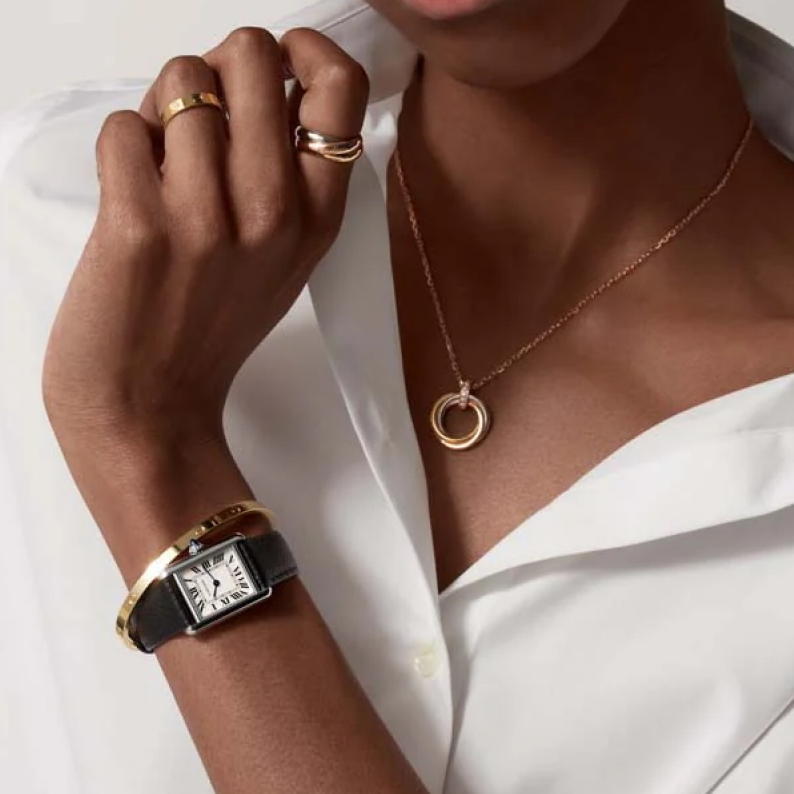
When it comes to ladies’ dress watches from Cartier, two names come to mind: the Cartier Panthère and the Cartier Tank Française. Both are instantly recognizable, both carry decades of design history, and both sit comfortably in the category of watches that never feel dated.
A Look Back at Their Origins
The Tank origin story begins in 1917, when Louis Cartier designed a rectangular watch inspired by the shape of military tanks seen during World War I. Over the decades, that idea evolved into many variations, each with its own personality. The Tank Française arrived in 1996 and its integrated metal bracelet and gently curved case gave the traditional Tank a sportier presence. It appealed to a younger audience and quickly became one of the most popular Tank models.
The panther has been Cartier’s motif since 1914, but the Panthère watch itself made its debut in 1983. With its soft square case and fluid bracelet, it captured the confident glamour of the era. The watch was discontinued in the mid-2000s, which only added to its allure. When Cartier reintroduced it years later, the Panthère found a whole new generation of admirers who appreciated its jewelry-like silhouette.
Shared Cartier Trademarks & Differences
At first glance, the Panthère and the Tank Française clearly come from the same house. Both feature classic Cartier details such as black Roman numerals, blued steel sword-shaped hands, and a blue cabochon set into the winding crown. The dials are clean and balanced, finished with a railway minute track that frames the center without overpowering it. These shared elements give both watches that unmistakable Cartier look.
The Panthère is defined by its soft square case with rounded edges. It sits gently on the wrist and feels almost like a piece of fine jewelry that happens to tell time. The Tank Française, by comparison, leans toward a rectangular shape that borders on square, with slightly curved corners. On the wrist, the Panthère tends to melt into the arm, especially in smaller sizes. The Tank Française feels more grounded and substantial, even when worn in its smaller configurations.
Bracelets also play a major role in how these watches wear day to day. The Panthère features a distinctive five-link bracelet that looks almost brick-like in construction. Each link is smoothly finished, allowing the bracelet to drape effortlessly around the wrist. This flexibility adds to the watch’s elegant, jewelry-forward feel.
The Tank Française uses a cleaner three-link bracelet that feels more streamlined. The case design extends outward to form bold vertical brancards that act as lugs, holding the bracelet firmly in place. Unlike the Panthère, the Tank Française has no crown guards, which keeps the design crisp and uncomplicated. The result is a bracelet and case combination that feels sporty yet polished.
Get to Know the Panthère and Tank Française Collections
One of the biggest considerations for buyers is the diameter of the case. Cartier Tank Française sizes range from small to medium and large, making it easy to find a version that suits your wrist and style. The material is made from either steel or 18k yellow gold. Diamond-set bezels are also available, along with quartz movement for the smaller sizes and automatic movement for the large one.
Cartier Panthere sizes offer similar flexibility, with its mini, small, medium, and large case sizes. This range allows the Panthère to keep its classic proportions whether you prefer a subtle, delicate look or a bolder statement. The Panthère is available in stainless steel, yellow gold, two-tone combinations, and diamond-adorned versions.
Which Should You Choose?
When shoppers compare Cartier Panthere vs Tank Française, the decision often comes down to whether they prefer a jewelry-forward design or a more sporty one. The Panthère leans dressier, thanks to its fluid bracelet and softer lines. It pairs beautifully with evening wear and polished daytime looks, and it often feels like an extension of your jewelry.
The Tank Française feels slightly more casual and versatile. Its structured case and integrated bracelet make it an easy companion for daily wear, whether you’re in a tailored suit or a relaxed weekend outfit.
There is no wrong answer when deciding between these two icons, and ultimately, it all comes down to personal style and how you want your watch to feel on your wrist.
